


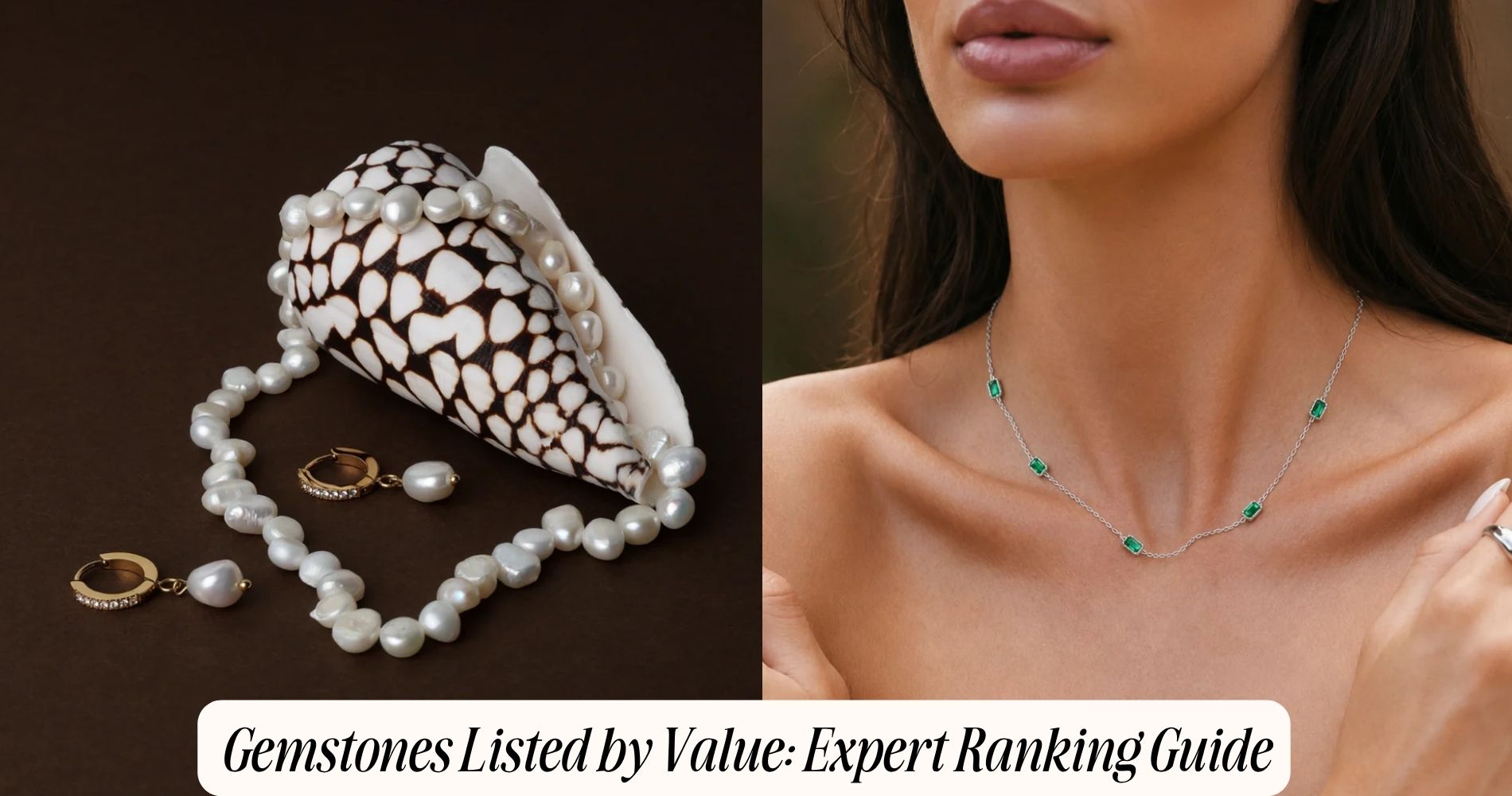
Gemstones Listed by Value: Expert Ranking Guide
Most gemstone value guides answer one question: which stone costs more per carat. They rarely ask the more useful one: valuable for what purpose? Gemstones listed by value look different depending on whether you're evaluating auction records, daily wearability, or long-term investment. A diamond scores a 10 on the Mohs hardness scale and survives decades of daily contact; a tanzanite scores a 6.5 and requires genuine care to stay pristine. Understanding both dimensions changes which gemstones make sense for a piece you'll actually wear.
The Stone Collection applies that logic: stones selected for how they look and perform through daily wear, not just how they rank on a price chart. This guide covers what drives gemstone value, how the major stones rank, and how durability shapes which gems hold up over time.
What Makes a Gemstone Valuable
Before reviewing gemstones listed by value, understanding the framework behind those rankings prevents the numbers from being misleading. Four variables interact to determine what any gemstone is worth.
| Factor | What It Measures | High Value Signal | Low Value Signal |
|---|---|---|---|
| Color | Hue, tone, and saturation | Vivid, even, fully saturated | Pale, gray-masked, or uneven |
| Clarity | Presence of inclusions | Eye-clean, no visible flaws | Visible inclusions, cloudiness |
| Carat weight | Mass of the stone | Large stones in rare gem types | Large stones in common varieties |
| Rarity | Supply relative to demand | Limited geographic sources | Widely available worldwide |
Color is consistently the dominant value driver for colored gemstones. A ruby's value concentrates almost entirely in the intensity and purity of its red: the benchmark is "pigeon's blood," a vivid, slightly bluish red with no visible gray or orange mask. A 2-carat ruby with that color is worth more per carat than a clean but pale ruby at 5 carats. The same logic applies across sapphires, emeralds, and virtually every other colored stone.

Clarity interacts differently across gem types. Diamonds are graded on a precise scale from Flawless to Included. For emeralds, visible inclusions are expected; an eye-clean emerald commands a dramatic premium precisely because it is so unusual. Rarity is the underlying driver behind all of this: Kashmir sapphires command premiums because their deposits are essentially exhausted, and Colombian emeralds command premiums because their geology produces a color no other source replicates.
Precious Gemstones Ranked by Market Value
The traditional "Big Four" covers diamonds, rubies, emeralds, and sapphires. It remains a useful starting framework, though some stones outside this group command prices that exceed mainstream sapphires and emeralds at equivalent quality.
Diamond: White diamonds at fine quality range from $4,000 to $20,000 or more per carat. Fancy color diamonds operate at a different scale. The Oppenheimer Blue, a 14.62-carat vivid blue diamond, sold for $57.5 million in 2016.
Ruby: Fine unheated rubies from Myanmar or Mozambique reach $1.18 million per carat at top quality. Most vivid rubies have been heat-treated; untreated fine stones are genuinely scarce, which is the core driver of value at the highest tier.
Emerald: The only Big Four stone where inclusions are expected rather than penalized. Colombian emeralds produce a vivid green no other source fully replicates. Top-quality Colombian material can reach $305,000 per carat, and origin documentation adds measurable value.
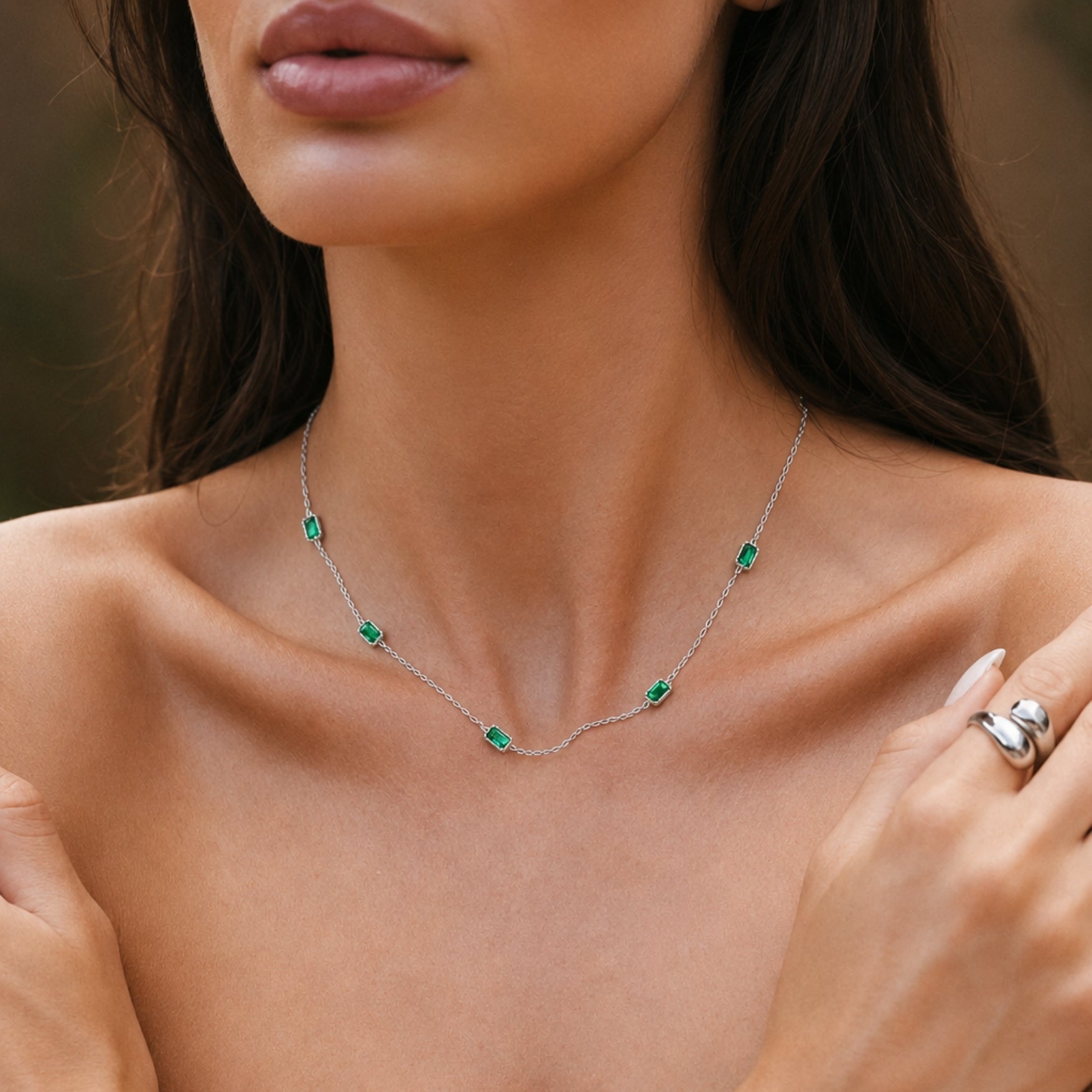
Blue Sapphire: The most prized sapphires come from Kashmir, a deposit that produced most of its material between 1880 and 1925 and is now effectively exhausted. Ceylon and Burmese material follow in the value hierarchy, with Kashmir stones commanding premiums that reflect their irreplaceable origin.
High-Value Stones Beyond the Big Four
Several gemstones outside the traditional precious category regularly command prices that exceed mainstream colored stones at equivalent quality.
Alexandrite displays a dramatic color change between daylight (green to bluish-green) and incandescent light (purplish-red to raspberry). Fine Russian material reaches $70,000 per carat. At Mohs 8.5, it is also one of the more durable high-value colored stones.

Paraiba tourmaline from northeastern Brazil produces a neon blue-green from copper and manganese within the crystal. Original deposits are nearly exhausted. Fine specimens range from $15,000 to $50,000 or more per carat.
Tanzanite exists only near Mount Kilimanjaro in Tanzania. Prices run $1,200 to $1,500 per carat and are rising as deposits deplete. A Mohs hardness of 6 to 6.5 is a real consideration for how it is worn.
Spinel spent centuries being mistaken for ruby. Fine Burmese red and pink spinels reach $10,000 to $15,000 per carat, and Mohs 8 hardness makes it one of the most undervalued durable colored stones relative to its quality.
How Durability Shapes Practical Gemstone Value
The Mohs scale measures scratch resistance and is the most practical guide to which stones handle friction and daily contact without surface degradation.
| Gemstone | Mohs Hardness | Daily Wear Suitability | Key Consideration |
|---|---|---|---|
| Diamond | 10 | Excellent | Can chip at sharp angles despite hardness |
| Ruby / Sapphire | 9 | Excellent | Very few practical limitations |
| Spinel / Alexandrite | 8 to 8.5 | Very good | Minimal for most daily use |
| Aquamarine / Morganite | 7.5 to 8 | Good | Avoid sharp impacts |
| Amethyst / Citrine | 7 | Moderate | Surface dulls with heavy contact over time |
| Tanzanite / Opal | 6 to 6.5 | Requires care | Scratches and chips more readily |
| Pearl | 2.5 to 4.5 | Delicate | Perfume, sunscreen, and sweat affect luster |
Ruby and sapphire are the most practical high-value colored stones for daily wear. A sapphire ring worn through a gym session or a beach day holds its surface far better than tanzanite or opal in the same conditions. Softer stones suit pieces with less contact: pendants and earrings that don't spend time pressed against a desk or a gym bag. A tanzanite earring is a far more practical piece than a tanzanite ring for anyone who keeps jewelry on through daily activity.

Frequently Asked Questions
What is the most valuable gemstone in the world?
By price per carat, vivid blue diamonds hold the record. The Oppenheimer Blue sold for $57.5 million at 14.62 carats in 2016. Among colored stones, fine unheated Burmese rubies and Kashmir sapphires hold the highest consistent per-carat values, with top rubies exceeding $1 million per carat.
How are gemstones listed by value?
Gemstones listed by value are ranked by four factors: color quality, clarity, carat weight, and rarity of geographic origin. Color is the most important variable. A vivid, saturated ruby at 2 carats is worth more per carat than a pale ruby at 5 carats. Origin premiums for Kashmir sapphire, Colombian emerald, and Burmese ruby reflect supply limitations no current source fully resolves.
Are semi-precious gemstones less valuable than precious stones?
Not always. Fine alexandrite at $70,000 per carat and Paraiba tourmaline at $50,000 per carat exceed most sapphires and emeralds at equivalent quality. The precious vs. semi-precious distinction is a historical marketing category, not an accurate value framework. Evaluating color, clarity, rarity of origin, and treatment status for each stone individually gives a more accurate picture.
Which gemstones hold up best for everyday jewelry?
Ruby and sapphire at Mohs 9 are the most practical high-value options for daily wear. Spinel at Mohs 8 is an underappreciated durable choice. Tanzanite, opal, and pearl suit pendants and earrings better than rings and bracelets for anyone who keeps jewelry on through active daily use.
Does a gemstone's origin affect its price?
Yes, significantly. Kashmir sapphires command premiums of 30 to 50 percent or more over equivalent Ceylon or Burmese material because the deposit is exhausted and the color quality is unreplicable. Colombian emeralds and Burmese rubies carry similar origin premiums. Origin must be verified by a reputable lab such as GIA, Gubelin, or SSEF to carry weight in pricing.
Conclusion
The clearest way to read gemstones listed by value is through two lenses: what a stone is worth on the market, and what it is worth to someone who wears jewelry every day. A Kashmir sapphire represents genuine rarity at $50,000 per carat; a well-cut spinel at $3,000 per carat may be the more practical choice for a ring worn through a swim or a workout. The stone collection applies that thinking: pieces where the stone choice reflects real wear conditions rather than just where the gem lands on a price chart.





Leave a comment
This site is protected by hCaptcha and the hCaptcha Privacy Policy and Terms of Service apply.